
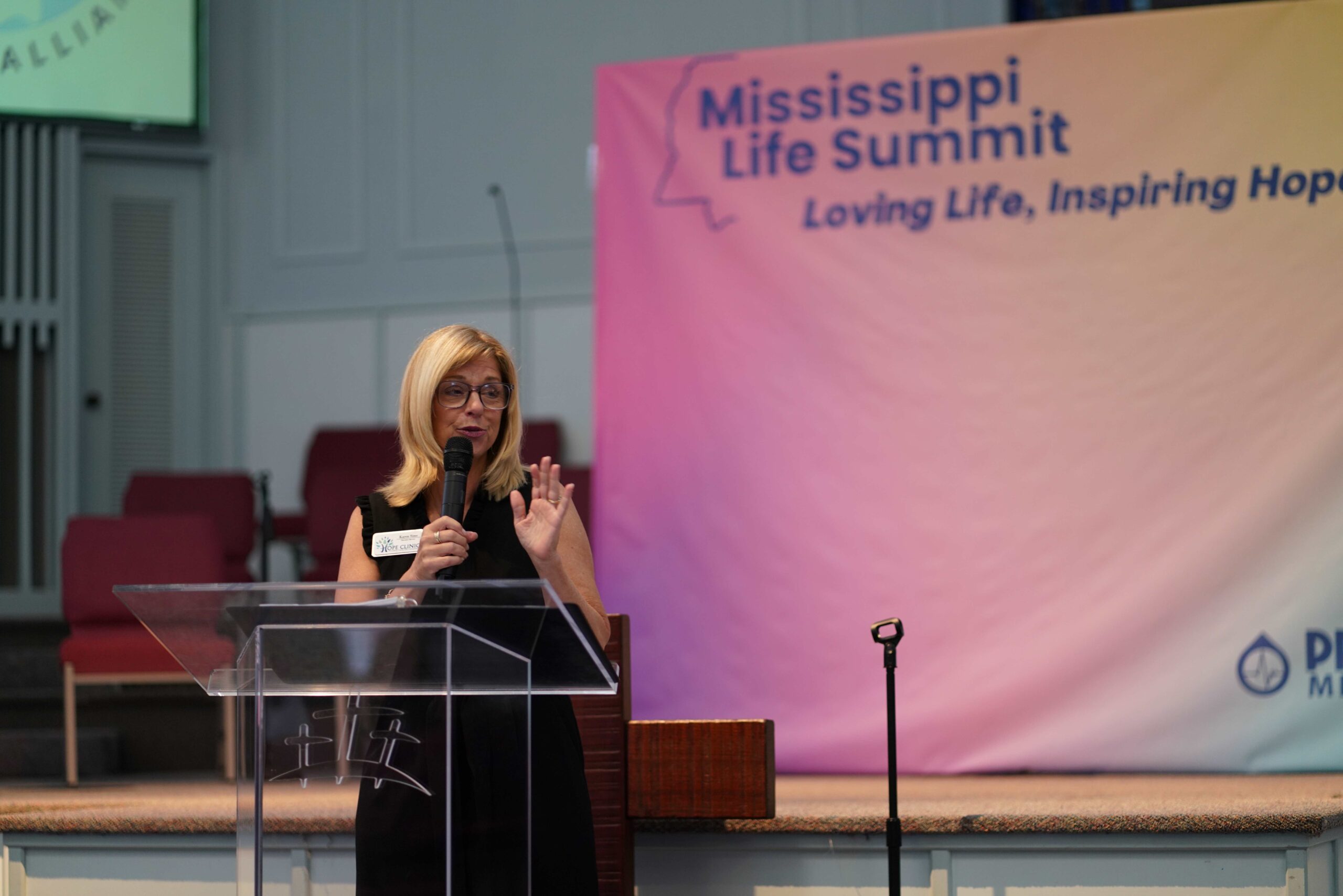
Note: At the Mississippi Life Summit, Karen Sims led this session discussing the history and legacy of pro-life support both nationwide and in Mississippi. Karen Sims is the Executive Director of Hope Clinic in Hattiesburg and leads the Mississippi Pregnancy Resource Alliance.
It’s important for us to know where we come from and how the ‘hand of God’ has worked in our lives. We should remember those who came before us because they laid the foundation for where we are today. We learn from the challenges of the past, celebrate our wins, and look ahead to what lies ahead of us.
Today, I will give you a broad overview of the history of abortion and life-affirming work both nationwide and in Mississippi. The life-affirming work demonstrates the ‘hand of God’ present in our lives. ‘But God’ moments in time and history refer to those pivotal moments when God’s mercy intervenes and demonstrates the ‘hand of God’ at work in our lives. (Ephesians 2:4) I will share some harsh truths, but we will also rejoice and be hopeful for what God has in store for us in the future.
Brief History of Abortion
Abortion has been a known practice throughout history, especially in Ancient Egypt and the Greek and Roman Empires. In the Bible, we read in Exodus 1 the story of Pharaoh ordering the midwives to commit birth selection abortions by killing baby boys during labor. However, the Hebrew midwives said (But God moment) that the women were too vigorous, and they delivered the baby before they could get there.
Later in the 19th and 20th centuries, we see the approval of abortion shift back and forth. Following many waves of the feminist movement in the 1900s, women wanted to have smaller families by limiting the number of children. In 1916, the first birth control clinic in the United States opened in New York by Margaret Sanger and her sister. Sanger’s clinic later evolved into Planned Parenthood. Margaret Sanger was a nurse, writer, and advocate for birth control/sex education. In the 1960s, she joined two men who helped to make abortion legal – Larry Ladner and Bernard Nathanson. Ladner and Nathanson saw abortion as a reasonable answer to the problem of ill-conducted abortion, population control, as well as a backup in case birth control did not work.
Bernard Nathanson was an abortionist, an atheist, and an abortion crusader. He performed over 160,000 abortions, including one of his own children. He presided over the largest abortion clinic in the world. But God – one day Nathanson found God and later received Christ. Then, he wrote a book called The Hand of God.
In the 1970s, New York legalized abortion. The first free-standing abortion clinic was opened in 1970 in Syracuse, NY.
In 1973, the U.S. Supreme Court released its ruling in the Roe v. Wade case. The plaintiff ‘Roe’ was Norma McCorvey. She never had an abortion, but one day she found God and eventually joined the pro-life movement. Throughout her life, McCorvey struggled with drug addiction and also worked at an abortion clinic. Eventually, she connected with Christians associated with Operation Rescue, who led her to Christ.
In 1990, the American College of Obstetrics and Gynecology (ACOG) went public on the importance of quality abortion care. After this, OB/GYN residency programs started to include abortion training in their curriculum. During this time, fewer doctors in the US were performing abortions because we had fewer abortion clinics available and fewer doctors willing to perform the procedure.
In 1980, the U.S. had 3,000 abortion facilities, including hospitals, doctors’ offices, and clinics. In 2020, there were 1,600 facilities. After the Dobbs decision, that number dropped slightly in some states and increased in other states. Also, national organizations started to pay for women to travel to different states to have late-term abortions.
Since 1973, it is estimated that 63,000,000 lives have been terminated through abortion. We saw the ‘hand of God’ in December 2021 when Dobbs v. Jackson Women’s Health Organization was argued before the US Supreme Court. The case challenged the Mississippi law making most abortions after 15 weeks illegal. Then, on June 24, 2022, Roe v. Wade was overturned. The Supreme Court held that abortion is not protected under the Constitution and returned the decision to the states.
Where are we now after Dobbs?
We also see the ‘hand of God’ in that there are now 12 states that have outlawed abortion with some exceptions. Twenty-nine states have laws based on gestational age. Nine states and Washington, D.C., have laws that place no limits on how late an abortion can be performed.
What are the reasons for abortion?
The reasons for abortions have not changed over the years. In 2021, a study by the Charlotte Lozier Institute revealed that 95.9% of abortions are elective. Another study by BioMed Central found women seek abortions for a wide range of reasons: 40% for financial reasons, 30% for partner-related concerns, and 29% for concern about their other children. Various studies have shown the same results. Around 60-70% of women choose an abortion due to a lack of support. The majority do not want to have an abortion, citing that it is inconsistent with their values or is coerced. To help women, we must see it from her eyes, and we must see her from God’s eyes.
What do these studies tell us? It’s pretty simple. Women need support and encouragement. Women need life-affirming organizations. A CDC surveillance report of women who had an abortion in 2022 said 57% were in their 20s, 39% were black, 88% were unmarried, and 56% had no previous abortions.
The Abortion Pill
The abortion pill accounts for nearly 2/3 of all abortions in the U.S. Heartbeat International says that 22% of women report receiving the abortion pill from the internet or a friend. There’s an abundance of availability and easy access to abortion pills, primarily due to the profitability. Abortion providers advertise the drug with phrases like ‘it’s a pain-free abortion,’ ‘100% effective,’ or ‘harmless.’ The websites have little to no information on the gestational limits, the dangers, or follow-up medical care.
Why is this dangerous? Some women are stockpiling for future use. There are known cases where women have been given the pills without their knowledge. Traffickers can force their victims to take the abortion pill. Suppose the woman is further along than 10 weeks in their pregnancy or has an undiagnosed ectopic pregnancy. In that case, the abortion pill will increase the risk of adverse events, like hemorrhaging or infection. Women are often alone in their moment of crisis.
Is the abortion pill effective? The FDA stopped tracking adverse effects of the abortion pill in 2016. Only deaths are reported. Some studies have shown the complication rates from the abortion pill are 4 times that of surgical abortion. A recent large study of insurance claims revealed that one in 11 women has an adverse event after taking the abortion pill within 45 days. Serious adverse events are actually 22 times higher than what the FDA claims on the label. To learn more, go to stopharmingowmen.org.
Abortion has become more accessible and less visible. The FDA oversight of chemical abortion and online sales of the drug are largely unregulated. The FDA’s protective guardrails have lessened over the years. When first approved for abortive use in 2000, the FDA required three in-person doctor visits. Today, none are required. In 2000, the maximum gestational age was 7 weeks. In 2016, that age limit was changed to 10 weeks.
Today, the woman has no human interaction during the process. They are isolated from beginning to end. We have hope because the current administration recently said they are going to take another review of the abortion pill. We know women deserve better. It’s not a policy debate; it’s a public health crisis.
We have much to celebrate because with the reversal of Roe v. Wade, the curse of abortion under the Constitution did not make it to its 50th year. We can celebrate the year of jubilee, signifying rest, liberation, and restoration. Mississippi was a part of that. I believe this has spiritual significance.
History of abortion in Mississippi
In 1966, Mississippi legislators made abortion legal in cases of rape and later incest. Family Health Services was the first abortion clinic that opened in 1975 and closed in 1979. Between 1976 and 1988, Mississippi had up to 8 abortion clinics, primarily located in Jackson, but also in Bay Saint Louis and Gulfport. In 1995, Jackson Women’s Health opened, and in 2010, the building was painted pink.
But God was also working through pro-life friends. Dr. Beverly McMillan is one of those stories. Dr. McMillan was the first doctor to perform abortions at a freestanding abortion clinic in Mississippi in 1975. But she is our next ‘hand of God.’ God changed her life, as many of you know. She eventually became pro-life. We are thankful for the work that she is doing here in Mississippi. I was fascinated by her incredible journey and the ‘hand of God’ that moved in her life, her heart, and her mind.
Beverly McMillan graduated from medical school in 1966. In 1969, she moved to Chicago, where she worked a rotation on the Infected OB ward, where she treated young women who were coming from botched abortions. After this experience, Dr. McMillan wanted better for women. She reasoned that legal abortion was the answer, even though she knew life began at conception. In 1975, Dr. McMillan moved to Jackson and was introduced to a few people who wanted to open an abortion clinic in Mississippi. This is where the ‘but God’ journey began. She eventually encountered the power of the Holy Spirit and learned she could not deny the presence of God. Dr. McMillan’s conversion didn’t happen overnight. Her work at the clinic became increasingly difficult, and eventually she stopped performing the abortions herself. In 1978, she was baptized and resigned from the clinic altogether. In 1980, she was invited to a pro-life meeting by Dr. Paul Fowler, who had organized Jackson Right to Life, which is now Pro-Life Mississippi. Dr. Beverly McMillan said this is where her medical knowledge was filtered through the scripture. To me, this is a beautiful example of how God is patient with us, exposing us to His truth over time and extending His grace at just the right time.
So many other abortion doctors did not have the same positive outcome. Various doctors have provided abortions in Mississippi over the last 5 decades. Around 1986, Dr. Lipscomb provided abortions in the Jackson area. In the 1990s, a handful of doctors known as ‘circuit riders’ were hopping between Mississippi and Alabama and various abortion clinics. Between 1989 and 1993, Dr. Tucker was reported to be performing 60-70% of abortions in MS. In 1993, Mississippi reported 6000 abortions that were primarily recorded under Tucker, with one death report recorded. Tucker was sued for injury following an abortion and then eventually barred from practicing medicine. In 1995, abortion reporting fell to 3500. In the early 1990s, Dr. Booker began performing abortions in Gulfport and Jackson. He stated that he performed about 30-40 abortions a day. Later, he faced bankruptcy, patient lawsuits, and charges of tax evasion.
As difficult as it is for me to share all of these adverse outcomes from those who performed abortions, I know we need to remember the past and the struggles that our leaders within our state have gone through over the years. When Mississippi was left with one remaining abortion clinic, it became increasingly difficult for the clinic to retain a doctor. They were never able to employ a doctor within the state. From that point on, the last abortion facility would fly in about seven different doctors.
In 2022, Mississippi reported 3,463 abortions, keeping in mind that this does not include women who went to other states or purchased the abortion pill online. Out of those 3,463 women who had an abortion in 2022, 77% were black, 22% white, and 94% unmarried. In the future, we won’t ever see these kinds of statistics in Mississippi because it’s hard for us to track when women are ordering the abortion pill online or going out of state. The reason we’re seeing these reports today is largely thanks to our leaders and legislators who worked hard within our state.
The life-affirming work of the Mississippi laws
Mississippi had the most conservative pro-life laws, which were the ‘hand of God’ that saved countless lives. Over the years, there were also wins in our legal system that saved lives, too. Some of Mississippi’s life-saving laws included a 24-hour waiting period, informed consent, parental consent, and an ultrasound requirement, among others. Between 2000 and 2018, Mississippi couldn’t outlaw abortions, but we could regulate ambulatory surgical rules to stop some abortions. These clinic regulations saved lives.
In 2018, the Gestational Age Act was passed, which outlawed abortion after 15 weeks of gestation with exceptions. The law was immediately challenged in court and eventually made it to the US Supreme Court as the Dobbs case. We cannot forget our lawmakers and leaders who help make all this possible: Sam Mims, Andy Gipson, Alex Monsour, Brian Aldridge, Becky Currie, Terri Herring, Philip Gunn, Joey Fillingane, and Governor Phil Bryant. Incredibly, Mississippi was a catalyst for change that impacted the whole nation.
Believing Roe could be overturned was part of a visionary strategy for a future without abortion. In 2007, there was a ‘trigger law’ that was designed to outlaw abortion if Roe v. Wade was overturned. Having this law in place allowed Mississippi to move quickly following the Dobbs decision.
In June 2022, the Dobbs decision overruled Roe. I could feel the energy all the way from DC. In July of 2022, Jackson Women’s Health closed, and the building was sold. In 2024, Planned Parenthood Southeast Mississippi closed in Hattiesburg.
0 Comments