
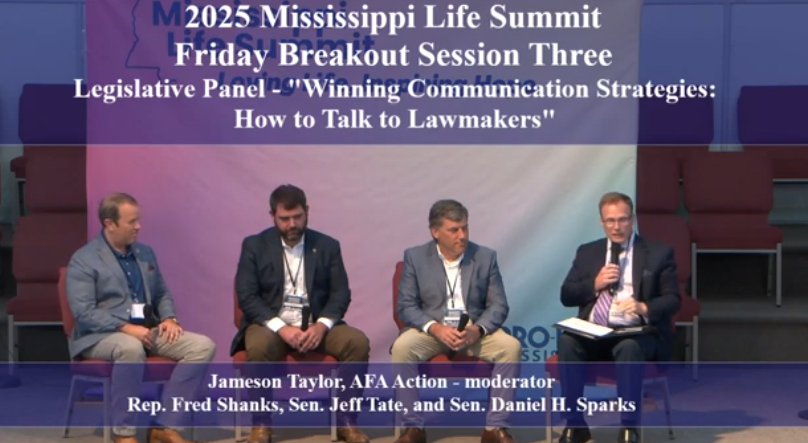
At the 2025 MS Life Summit, Dr. Jameson Taylor, director of the Center for Government Renewal for AFA Action, moderated a legislative panel session featuring three distinguished Mississippi lawmakers: Senator Daniel Sparks, Representative Fred Shanks, and Senator Jeff Tate. The session offered a wealth of practical advice for citizens, advocates, and lobbyists seeking to engage effectively with their state legislators.
Why State Lawmakers Are “Diamonds”
Dr. Taylor described state lawmakers as “diamonds,” emphasizing their critical role in shaping local policy. “State lawmakers are really the ones that are doing good in their communities,” Taylor said, noting that major changes, like the overturning of Roe v. Wade, started at the state level. Building relationships with these lawmakers can lead to meaningful change.
What NOT to Do: Common Pitfalls in Advocacy
The panelists shared examples of ineffective approaches to lawmakers. One “bad example” highlighted in the session involved confronting a legislator walking into church, and launching into a forceful pitch: “I have an important bill that I need to talk to you about… If you disagree with me, I’m sure you’re not pro-life. God told me that you need to introduce this bill. If you don’t do it, I will go on social media and attack you.”
The panel’s advice: Don’t make these mistakes. Don’t approach a lawmaker as they’re walking into church, a restaurant with family, a meeting, or court. Don’t set unrealistic expectations for introducing a bill—know the proper timing to get it introduced. Don’t threaten lawmakers with attacks of any kind.
Three Tips to Effectively Communicate with Lawmakers
- Understand That Lawmakers Are Busy: “When approaching a lawmaker about a bill, you need to get to the point within 2 minutes,” advised Dr. Taylor. Lawmakers juggle legislative duties, family life, and other jobs. The base salary for a Mississippi legislator is $23,500 a year, making their position a true public service.
- Show Up: Being present at the Capitol helps build trust. Lawmakers appreciate constituents who make the effort to meet them in person. Lawmakers notice advocates who consistently show up for important issues.
- Create Opportunities for Lawmakers to Show up: Organize events like prayer breakfasts or community meetings where lawmakers can connect with constituents. Sharing your “political capital” helps them engage with the community. Use your networks and events to help lawmakers connect with the community. This strengthens your partnership and their visibility.
Build Relationships and Trust
Representative Shanks stressed the importance of genuine relationships. “The more that we talk, the more I get to know you.” Meeting lawmakers at the Capitol, even briefly, can start a relationship and build trust. Be patient—passing legislation often takes several sessions, and lawmakers face strict deadlines throughout the year.
Be Concise, Prepared, and Respectful
Dr. Taylor recommends an ‘elevator pitch’ – a one- or two-minute presentation of what you want to talk about. First, introduce yourself. Second, say who you’re with and where you live. What is your connection to their voters? Thirdly, say why you are talking to them. Finally, give them a one-page fact sheet with your photo and phone number. Keep in mind, legislators receive a lot of handouts. Make your materials memorable and concise.
A Typical Day in the Life of a Lawmaker: Panelist Perspectives
Senator Daniel Sparks: “I serve in Itawamba, Tishomingo, and Prentiss counties in northeast Mississippi. No day is typical because they’re all different. I’m an attorney by trade and have been in the legislature for six years. When you first get elected, there’s a period of learning the legislative process. It’s about how an idea becomes law. For example, today I was in the AG’s office for an hour meeting with some folks, then in the capital for about an hour. On Sunday, I will celebrate one of my small-town mayor’s retirement after 20 years of service. I always want to be engaged with city and county leaders. A lawmaker is a part-time job, but the needs are full-time. In the fall, I try to prepare for the upcoming January with legislative work. During the year, I’m in court quite a bit, so there are days that I walk into the courtroom at 8:30 and walk out at 5:00. After 5:00 pm, I’ll return phone calls or text messages. I rely on colleagues, experts, and advocates to bring me the details on issues in the field. I rely on advocates such as yourself to be educated because if I’m going to try to motivate people, I have to know what I’m motivating them to do.”
Senator Jeff Tate: “I represent the Meridian area. I got involved in politics after I graduated from high school. At age 20, I ran for the local office of election commissioner. The election commissioners oversee your elections. In 2019, I ran for state senate, where I served as chairman of the senate elections committee for a few years and helped pass a lot of great legislation. I agree that there is no typical day for a legislator. For example, I’m in the retail and wholesale fireworks business, and it’s close to July 4—I went to my fireworks store, worked on some wholesale accounts, and made some retail sales. Then I jumped into a jacket and khakis, went down to Clark County, where we had a ribbon-cutting for Howard Industries. Afterwards, I came back to Meridian, got into some work clothes, and sold some more fireworks. Later that day, I got back into my suit, went to a ceremonial bill signing at our National Guard base, and then went back to my store.”
Representative Fred Shanks: “I’m a state representative out of Rankin County. Before running for state office, I was a city Alderman in Brandon. I feel that anybody who wants to get into politics at any level needs to have some municipal politics under their belt to see how much they really like it. I have really enjoyed serving. I get to help a lot of people. I’ve done anything from just helping get through red tape for people.”
Advocacy That Works: Practical Tips
- Personal Emails Matter: Mass emails often get filtered out. Personalized emails or letters are much more effective. If you write a letter, drop a postcard, or send a personal email, legislators pay attention.
- Do Your Homework Online: Senator Sparks explains, “View the floor debates and committee discussion available streaming on online platforms like YouTube. If there’s a bill that’s important to you, look up that bill number on the legislative website. Then, view the history of the action—has it passed out of the Senate committee? You can watch that Senate committee and hear the discussion. Viewing the discussion can help you tailor your pitch by showing you what others are saying about the bill. If you know which committee your bill is assigned to, then reach out to those on that committee to vote and clear the bill.”
- Know the Process: Understand legislative deadlines, committee assignments, and the collective nature of lawmaking. Each session’s deadlines are posted on the MS Legislature website at legislature.ms.gov.
When regular people build real relationships with their lawmakers, we create real change. Your voice makes a difference. Start today, show up, speak up, and let your voice help create a better future for everyone.
0 Comments